
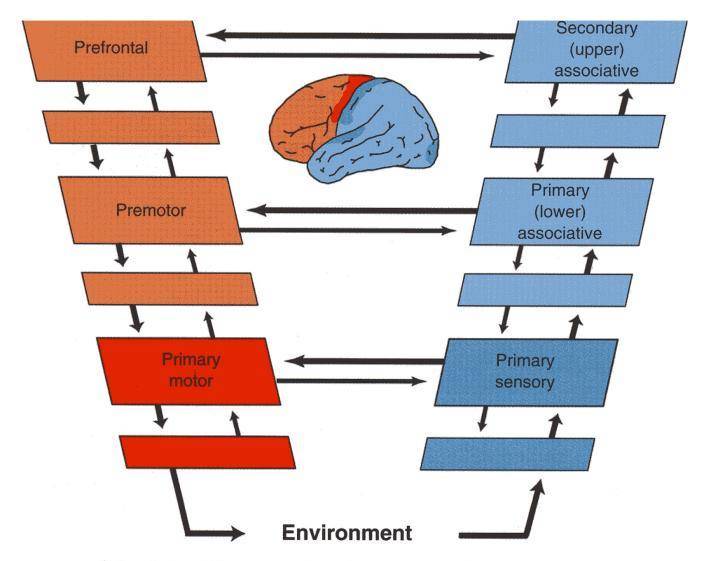

Have a look see at this chart used by neuroscientists Fuster, Crick and Koch to wrap your head around the gear-works of visual consiousness.Â
Our visual cortex doesn’t show us what it sees. Instead, it sneaks maps of reality in front of our consciousness that influences us to do things before we even know what we’re doing.
And those playful neurons in charge of visuals our consciousness sees? (shapes, contrasts, ect.) They’re all coked up – continually remapping the information until it finally reaches our frontal lobes. (conscious awareness).
Not done yet, though. The frontal lobes decide to make it’s own questionable, at times freshman-like, edits before screening it to our consciousness as objective journalism.
What we “see” is far removed from what our brain sees.
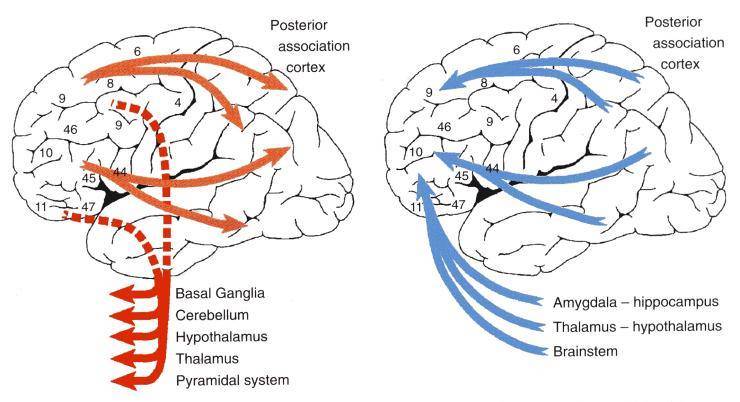
Here’s another way to “look” at it. Our consciousness, in our frontal lobes (where the blue arrows point) is the last in line to react/respond to the world.Â
Yet, our thoughts can reshape everything we see and do by sending information (from our imaginary sense of the world) to the rest of the brain and body (red lines).
But at the end of the day, we just can’t consciously see how the world is in actuality. But, I think that’s ok.
Dive Deeper
Fuster JM. Neuron. 2001 May;30(2):319-33.

2-3X Your
Learning Speed

You May Be More Negative Than You Think
A negative mentality is profoundly harmful to the the circuitry of the brain. But no need to respond negatively to that fact.

How You Can Practice More Effectively
Ah, you seek to master the art of [insert skill here], do you? Sorry lazybones, but I’m afraid that means

Can Too Much Happiness Harm You?
Being happy is a great idea. BUT there are some gotchas to look out for if you’re a tad TOO

How to Enhance Your Memory with Simple Learning Hacks
Admission: I’m often forgetful. In fact, I’ve forgotten more things than I can remember. But, don’t get too smug.


https://theoneyoubelieve.wordpress.com/2015/05/15/what-visage-do-you-engage-and-what-engages-your-visage/